Research Article | | Peer-Reviewed

Response of Tomato Irrigation Water Needs to Climate Change at Gobu Seyo, Ethiopia

Received: 29 September 2025     Accepted: 14 October 2025     Published: 31 October 2025
Views:       Downloads:
Abstract

The aim of the research was to examine how climate change would affect the amount of water needed for tomato irrigation. The CROPWAT 8.0 software was utilized to model the total agricultural water usage and irrigation needs for current and upcoming decades. Projections were generated using a MarkSim-Global Climate Model alongside the output for medium (RCP4.5) and high (RCP8.5) emission scenarios. These predictions covered the baseline period (1990-2019) and expected scenarios (2023-2052) and (2053-2082). The results indicated that the water needs for agriculture concerning this crop increased by 3.85% to 7.21% in both scenarios (RCP8.5 and RCP4.5) and timeframes (2023-2052 and 2053-2082). In the high emission scenario (RCP8.5), peak crop water requirements were recorded during the mid-term period, while in the medium emission scenario (RCP4.5), a reduction was observed in the near-term phase. Water needs for crop irrigation varied between 2.48% and 8.15%. The most significant increase occurred with RCP8.5 in the mid-term, while RCP4.5 exhibited the least fluctuation in the near-term. The results indicate that future climate alterations will greatly impact the water and irrigation requirements for agriculture. Farmers, water managers, water user associations, and policymakers are encouraged to collaborate in the future to enhance crop production, water storage, and distribution to increase the currently low efficiency of water utilization.

Published in International Journal of Economy, Energy and Environment (Volume 10, Issue 5)
DOI 10.11648/j.ijeee.20251005.11
Page(s) 134-140
Creative Commons

This is an Open Access article, distributed under the terms of the Creative Commons Attribution 4.0 International License (http://creativecommons.org/licenses/by/4.0/), which permits unrestricted use, distribution and reproduction in any medium or format, provided the original work is properly cited.

Copyright

Copyright © The Author(s), 2025. Published by Science Publishing Group

Keywords

Climate Change, Scenarios for Emissions, Water Needs for Irrigation, Anticipated Irrigation Demand

1. Introduction
The prolonged global climate variations over millennia have affected both natural ecosystems and human systems . Recently, these changes have been occurring more quickly and unpredictably than in previous decades, evidenced by alterations in rainfall volumes, distribution, patterns, increasing temperatures, rising sea levels, escalating greenhouse gas (GHG) emissions, and more common floods and droughts . Africa is recognized as the continent most ill-equipped to cope with climate change due to its limited capacity to adapt and heavy reliance on climate-sensitive sectors like rain-dependent farming .
Despite the global impacts of climate change, it remains valid. It is commonly acknowledged that the two main impacts of climate change are rising temperatures and changes in precipitation patterns, both of which significantly impede sustained economic growth and agricultural productivity in Africa, especially in Sub-Saharan African (SSA) countries . Ethiopia is among the Sub-Saharan African nations that are particularly susceptible to the effects of climate change and variability . Ethiopia often encounters droughts and fluctuations in both the quantity and distribution of seasonal and annual rainfall, which are the predominant climate-related issues faced by the nation . These occurrences greatly influence the country's economic and social development, as well as the productivity of rainfed agriculture.
Ethiopia encounters major climate-related challenges, including regular droughts and variations in the quantity and distribution of seasonal and annual rainfall, negatively impacting rainfed agricultural production and obstructing the nation's economic and social development . Ethiopia's largest economic sector, agriculture, is responsible for over 80% of employment, half of the GDP, and the bulk of foreign exchange revenues . The agricultural sector largely depends on natural rainfall, as just around 5% of Ethiopia's terrain has irrigation . Changes in climate and increased temperatures result in heightened evaporation demands, which in turn affect crop yield. Approximately 95% of agricultural production reliant on rainfall is affected by climate change . As a result, variations in the amount or distribution of rainfall pose serious risks to agricultural yields, causing direct impacts on the nation’s food production and security. Climate change impacts irrigated agriculture, making it more vulnerable than rainfed farming . Factors like soil temperature, moisture content in the crop root zone, and general soil moisture conditions throughout the growing season are all influenced by climate change . It also affects farming yield, water usage, efficient water allocation, and the accessibility of irrigation. Understanding the historical and upcoming patterns of temperature and rainfall distribution is essential for effective planning and decision-making. To improve agricultural productivity, the Ethiopian government must acquire timely and precise climate change information to create effective mitigation strategies. The main aim of this study is to investigate how different climate change scenarios might affect the irrigation water needs for tomato cultivation in Gobu Seyo wereda, Ethiopia.
2. Materials and Methods
2.1. Research Location
Gobu Seyo Wereda lies 265 kilometers west of Addis Ababa and is situated 65 kilometers from the Zonal Town of Nekemte in the Oromia Regional State's East Wollega Zone. The area's altitude ranges from 1600 to 1900 meters above sea level, with geographic coordinates of 9°09′N, 36°99′E.
2.2. Models
To meet the study's objectives, various tools were utilized: the MarkSim-GCM model output ensembles to evaluate impacts, CROPWAT for determining crop water needs, Excel for computing the double mass curve for consistency checks, and XLSTAT for performing the homogeneity test and managing gaps in rainfall data.
2.3. Source and Gathering of Data
Meteorological information: Long-term weather data (1990–2019) was supplied by the Bako Agricultural Research Centre.
2.4. Data on Crops and Soil
Data files related to crops, including Kc values, growth stage lengths, root depths, and crop depletion rates, were provided by the FAO Irrigation and Drainage Division . The soil texture, bulk density, field capacity and permanent wilting point were measured at depths of 0–20, 20–40, 40–60, 60–80, and 80–100 cm.
2.5. Creation of Climate Change Scenarios
The MarkSim GCM has recently been recognized as the most effective, particularly for use in Africa and Latin America . Two separate time frames were evaluated: the 2020s (2023-2052) and the 2050s (2053-2082), taking into account the RCP 4.5 and RCP 8.5 emission scenarios, by employing the ensemble average from seventeen atmospheric ocean climate models in the MarkSim-GCM. In order to achieve the goals of the study, projected scenario climate data were collected using this online software tool that utilized the aforementioned climate models sourced from http://gismap.ciat.cgiar.org.
2.6. Information for CROPWAT 8.0
2.6.1. Estimation of Reference Evapotranspiration
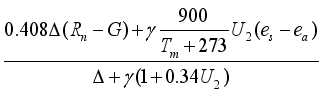
The sole recommended approach for calculating the reference crop evapotranspiration is the FAO Penman-Monteith method .
= (1)
Where: ETO indicates Reference evapotranspiration (mm/day), Δ refers to the Slope of the saturated vapor pressure curve (kPa °C–1), Rn represents Net radiation (MJ m–2 day–1), G denotes Soil heat flux density (MJ m–2 day–1), Tm indicates Mean air temperature (°C) at a height of 2.0 m, U2 is the Average wind speed at a height of 2.0 m (m s–1), es stands for Saturation vapor pressure (kPa) at the temperature Tm, ea is the Actual vapor pressure (kPa); (es – ea) represents the vapor pressure deficit (kPa), and γ is the Psychrometric constant (kPa °C–1).
2.6.2. Calculation of Effective Rainfall
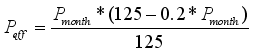
The USDA approach was utilized to assess the effective rainfall throughout the full growing season, taking into account its associated crop stages for the reference period and following seasons .
, for Pmonth<= 250 mm(2)
, for Pmonth> 250 mm(3)
Where: Peff is Effective precipitation; Pmonth is monthly precipitation.
2.7. Computation of Crop Water Needs
Utilizing the equation given, the water requirements for crops were assessed for both the baseline timeframe and potential future situations .
ETC=Kc * ETO(4)
Where: ETO is the reference crop evapotranspiration, Kc is the crop coefficient, ETC is defined as the evapotranspiration.
2.8. Irrigation Water Needs
Grasping the concept of effective rainfall and the water needs for crops has facilitated the recognition of irrigation water requirements (IWRs). IWR is determined by subtracting the effective rainfall (Pe, mm) from the crop water requirement (ETc, mm) .
IWR=
IWR= (5)
Where: Pe is effective rainfall (mm).
3. Results and Discussion
3.1. Climate Change Forecast
3.1.1. Estimated Yearly Precipitation
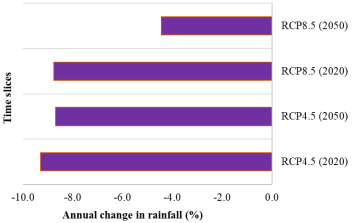
Figure 1 depicts the variations in average yearly rainfall percentages for the RCP 4.5 scenarios during the 2020s and 2050s, as well as the RCP 8.5 scenarios for these identical decades. An examination of annual rainfall showed a declining trend compared to the baseline years for all scenarios across the two-time frames of RCP 4.5 and RCP 8.5. In the RCP 8.5 scenario, average annual precipitation declines by approximately -8.75% in the 2020s and -4.44% in the 2050s, whereas in the RCP 4.5 scenario, reductions are seen at -9.28% in the 2020s and -8.69% in the 2050s relative to the baseline period. These findings are consistent with those stated in the previous study .
Figure 1. Anticipated variation in yearly precipitation based on future forecasts.
3.1.2. Forecasted Yearly Peak Temperature
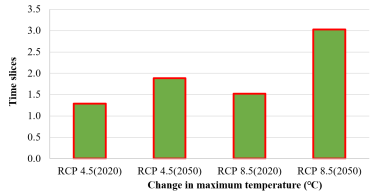
Regarding the yearly average maximum temperature (Figure 2), the shift in average annual maximum temperature for RCP4.5 during the 2020s and 2050s ranges from 1.29°C to 1.89°C, with the largest increase anticipated for RCP4.5 (2050s) and the smallest for RCP4.5 (2020s). Under RCP8.5, the range spans from 1.52°C to 3.03°C, with the greatest rise expected for RCP8.5 (2050s) and the smallest for RCP8.5 (2020s). These results are consistent with previous research findings .
Figure 2. Projected change in annual maximum temperature under future scenarios.
3.1.3. Forecasted Yearly Lowest Temperature
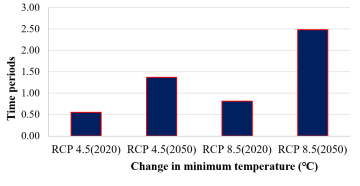
Regarding the mean annual minimum temperature (Figure 3), the difference in mean annual minimum temperature ranges from 0.55°C to 1.37°C when comparing RCP4.5 (2020s) to RCP4.5 (2050s), with the most significant change observed in RCP4.5 (2050s) and the least in RCP4.5 (2020s). In RCP8.5, temperature fluctuations vary between 0.82°C and 2.48°C, with the highest variation observed in RCP8.5 (2050s) and the lowest in RCP8.5 (2020s). The fluctuation in temperature in this region exceeds the alterations in minimum temperatures . It is expected that average temperatures in Ethiopia will rise by 0.8°C in the 2020s and by 1.2°C in the 2050s .
Figure 3. Forecasted variation in yearly minimum temperature under upcoming scenarios.
3.2. Impacts of Climate Change on Agricultural Water Requirements and Irrigation Water Consumption
3.2.1. Changes in Reference Evapotranspiration (ETO)
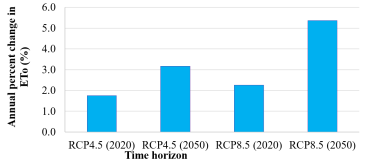
Figure 4. Yearly variation of reference evapotranspiration from the baseline period (1990-2019).
The ETO for RCP4.5 and RCP8.5 indicates an annual rise during the periods of 2023–2052 and 2053–2082, as depicted in Figure 4. In the RCP4.5 scenario for the 2050s, the growth rate of ETO exceeds that of RCP4.5 in the 2020s. The noted ETO variations were +3.18% for the 2050s under RCP4.5 and +1.75% for the 2020s. The trend in ETO stayed consistent for both RCP8.5 and RCP4.5. Under RCP8.5 for the 2050s, the increase was significantly greater at +5.37%, compared to a slight growth of +2.26% in the 2020s. This indicates that ETO rises as time goes on.
3.2.2. Modifications in Crop Water Needs and Irrigation Water Demands for Tomato Crop
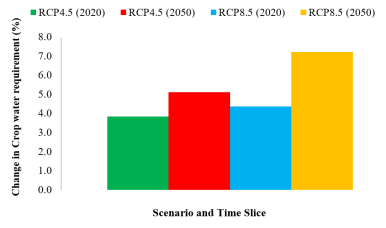
The assessment of water and irrigation requirements for tomato farming was conducted for the RCP4.5 and RCP8.5 scenarios across two different time periods, as illustrated in Figures 5 and 6 This evaluation revealed that the required water for tomatoes ranged from 3.85% to 7.21%, based on the circumstances and duration. The RCP4.5 projection for the 2020s indicated the smallest degree of change, whereas RCP8.5 for the 2050s revealed the most significant change. It was noted that there would be a greater need for agricultural water in the later period and in situations associated with higher emissions when evaluating both timeframes and scenarios.
This outcome is consistent with the previous results , suggesting that tomato crops will require more water under RCP4.5 and RCP8.5 compared to the baseline period, and it corresponds with the previous studies and . A steady reduction in the need for irrigation water for tomato plants was observed across various scenarios and time frames (Figure 6). Irrigation water needs varied between 2.48% and 8.15%, with RCP4.5 (2020s) exhibiting the smallest variation and RCP8.5 (2050s) facing the largest increase. That average irrigation water requirements will rise due to increasing temperatures .
Figure 5. Reaction of tomato crop irrigation needs to climate change.
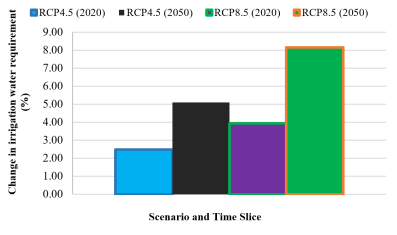
Figure 6. Reaction of tomato water needs for irrigation to climate change.

4. Conclusions
This study seeks to assess the anticipated variations in temperature and precipitation compared to the baseline period for the upcoming near and mid-centuries, along with the potential impacts of these variations on crop irrigation and water needs in the region, using the ensemble mean from seventeen MarkSim-GCM Atmosphere-Ocean climate models across two future scenarios. In addition, annual precipitation has decreased from the baseline period in all scenarios, with reductions ranging from -4.44% to -9.28%; the RCP4.5 scenario in the 2020s showed the most significant declines, while the RCP8.5 scenario for the same period reported the least. All scenarios and periods indicated an increase in the average maximum temperature relative to the historical period. The largest and smallest changes in mean maximum temperature were observed in RCP8.5 for the 2050s and RCP4.5 for the 2020s, measuring 3.03°C and 1.29°C, respectively. Moreover, changes in the average annual minimum temperature varied between 0.55 and 2.48 degrees Celsius, with the peak temperature recorded under RCP8.5 for the 2050s and the lowest observed under RCP4.5 for the 2020s.
The expected effects of climate change have resulted in a rise in the water needs for the selected crop. The greatest change occurred in RCP8.5 during the 2050s, while the least change was noted in RCP4.5 for the 2020s. Future projections for the water requirements of crop irrigation indicated a growing trend. In summary, it is expected that the projected water consumption and irrigation needs for the crop in the study area will rise. This is due to a decline in average annual rainfall paired with a rise in air temperatures. The subsequent recommendations ought to be viewed as improved options and additional methods for enhancing crop and irrigation water management and boosting crop yield in the study region.
1) Improving adaptation techniques in the Gobu Seyo wereda and advancing research on climate-resilient crops necessitates bolstering institutional capacities to gather crucial data, including access to agricultural and soil databases.
2) The findings indicate that future minimum and maximum temperatures are expected to rise. As a result, a range of strategies for adapting to and mitigating climate change must be implemented in the study area.
3) Rising temperatures and declining rainfall in the Gobu Seyo wereda have led to increased agricultural water usage and heightened crop water stress.
4) In response, the study area should adopt improved water collection methods, implement soil water conservation practices, and explore alternative irrigation solutions (such as small-scale irrigation water collection systems).
Abbreviations

CROPWAT

Crop Water

GCM

Global Climate Model

RCP

Representative Concentration Pathways

GHG

Greenhouse Gas

SSA

Sub-Saharan African

GDP

Gross Domestic Product

XLSTAT

Statistical Software

Kc

Crop coefficient

ETO

Reference Evapotranspiration

ETC

Crop Evapotranspiration

IWR

Irrigation Water Requirements

Pe

Effective Rainfall

Author Contributions
Habtamu Bedane is the sole author. The author read and approved the final manuscript.
Funding
I did not receive any funding for the publishing of this article.
Conflicts of Interest
The author declars no conflicts of interest regarding the publication of this paper.
References
[1] H. Birara, R. P. Pandey, and S. K. Mishra, “Trend and variability analysis of rainfall and temperature in the Tana basin region, Ethiopia,” pp. 555–569, 2018,
[2] P. Asare-nuamah and E. Botchway, “Heliyon Understanding climate variability and change: analysis of temperature and rainfall across agroecological zones in Ghana,” vol. 5, no. October 2019,
[3] S. H. Gebrechorkos, S. Hülsmann, and C. Bernhofer, “Long-term trends in rainfall and temperature using high-resolution climate datasets in East Africa,” pp. 1–10, 2019,
[4] E. Girvetz et al., “Future Climate Projections in Africa: Where Are We Headed?” pp. 15–27, 2019,
[5] K. Abera, O. Crespo, J. Seid, and F. Mequanent, “Simulating the impact of climate change on maize production in Ethiopia, East Africa,” Environ. Syst. Res., 2018,
[6] S. Gleixner, N. Keenlyside, E. Viste, and D. Korecha, “The El Niño effect on Ethiopian summer rainfall,” no. May 2016, pp. 1865–1883, 2017,
[7] S. K. Weldearegay and D. G. Tedla, “Impact of climate variability on household food availability in Tigray,” pp. 1–10, 2018,
[8] M. Abera, A. Wale, Y. Abie, and T. Esubalew, “Verification of the Efficiency of Alternate Furrow Irrigation on Amount of Water Productivity and Yield of Onion at Sekota Woreda,” vol. 9, 2020,
[9] S. B. Awulachew and M. Ayana, “Performance OF irrigation: An assessment at different scales in Ethiopia,” Exp. Agric., vol. 47, no. S1, pp. 57–69, 2011,
[10] G. F. Boru and O. Regional, “Impact of climate change on irrigated crop water use of selected major grown crops and water demand for irrigation: A case of Anger sub-basin, Nile basin of Ethiopia,” vol. 4, no. 9, pp. 452–464, 2020,
[11] C. S. Tan and W. D. Reynolds, “Impacts of Recent Climate Trends on Agriculture in Southwestern Ontario,” vol. 1784, 2013,
[12] M. Hanemann and A. Fisher, “Will U. S Agriculture Really Benefit from Global Warming? Accounting for Irrigation in the Hedonic Approach Department of Agricultural and Resource,” no. February 2005, 2014,
[13] FAO, “FAO Irrigation and Drainage Paper Crop by,” no. 56, 2012.
[14] P. G. Jones and P. K. Thornton, “Generating downscaled weather data from a suite of climate models for agricultural modelling applications,” Agric. Syst., vol. 114, pp. 1–5, 2013,
[15] R. G. Allen, L. S. Pereira, D. Raes, M. Smith, and W. Ab, “Crop evapotranspiration - Guidelines for computing crop water requirements - FAO Irrigation and drainage paper 56,” pp. 1–15, 1998.
[16] USDA-SCS, “Part 630 Hydrology National Engineering Handbook Chapter 10 Estimation of Direct Runoff from Storm Rainfall,” Natl. Eng. Handb., 1985.
[17] D. Bekele, T. Alamirew, A. Kebede, G. Zeleke, and A. M. Melesse, “Modeling Climate Change Impact on the Hydrology of Keleta Watershed in the Awash River Basin, Ethiopia,” Environ. Model. Assess., vol. 24, no. 1, pp. 95–107, 2019,
[18] D. Yadeta, A. Kebede, and N. Tessema, “Potential evapotranspiration models evaluation, modelling, and projection under climate scenarios, Kesem sub-basin, Awash River basin, Ethiopia,” Model. Earth Syst. Environ., vol. 6, no. 4, pp. 2165–2176, 2020,
[19] D. Conway and L. Schipper, “Adaptation to Climate Change in Africa: Challenges and Opportunities Identified from Ethiopia,” no. April 2016, 2011,
[20] B. T. Kassie, D. Pioneer, and H. Hengsdijk, “Climate variability and change in the Central Rift Valley of Ethiopia: Challenges for rainfed crop production Climate variability and change in the Central Rift Valley of Ethiopia: challenges for rainfed crop production” no. February, 2013,
[21] N. Tessema, A. K. Kassa, and S. Berhanu, “Impact of climate change on soil water availability and maize water needs in Kesem sub basin, middle Awash, Ethiopia. January 2017.
[22] S. Boonwichai, S. Shrestha, M. S. Babel, S. Weesakul, and A. Datta, “Climate change impacts on irrigation water requirements, crop water productivity and rice yield in the Songkhram River Basin, Thailand,” J. Clean. Prod., 2018,
[23] A. Berhe, H. Shiferaw, and A. Z. Abraha, “Maize and onion: the case of Gum-selasa small-scale irrigation,” J. Drylands, no. April, 2018,
Cite This Article
  • APA Style

    Bedane, H. (2025). Response of Tomato Irrigation Water Needs to Climate Change at Gobu Seyo, Ethiopia. International Journal of Economy, Energy and Environment, 10(5), 134-140. https://doi.org/10.11648/j.ijeee.20251005.11

    Copy | Download

    ACS Style

    Bedane, H. Response of Tomato Irrigation Water Needs to Climate Change at Gobu Seyo, Ethiopia. Int. J. Econ. Energy Environ. 2025, 10(5), 134-140. doi: 10.11648/j.ijeee.20251005.11

    Copy | Download

    AMA Style

    Bedane H. Response of Tomato Irrigation Water Needs to Climate Change at Gobu Seyo, Ethiopia. Int J Econ Energy Environ. 2025;10(5):134-140. doi: 10.11648/j.ijeee.20251005.11

    Copy | Download

  • @article{10.11648/j.ijeee.20251005.11,
      author = {Habtamu Bedane},
      title = {Response of Tomato Irrigation Water Needs to Climate Change at Gobu Seyo, Ethiopia
    },
      journal = {International Journal of Economy, Energy and Environment},
      volume = {10},
      number = {5},
      pages = {134-140},
      doi = {10.11648/j.ijeee.20251005.11},
      url = {https://doi.org/10.11648/j.ijeee.20251005.11},
      eprint = {https://article.sciencepublishinggroup.com/pdf/10.11648.j.ijeee.20251005.11},
      abstract = {The aim of the research was to examine how climate change would affect the amount of water needed for tomato irrigation. The CROPWAT 8.0 software was utilized to model the total agricultural water usage and irrigation needs for current and upcoming decades. Projections were generated using a MarkSim-Global Climate Model alongside the output for medium (RCP4.5) and high (RCP8.5) emission scenarios. These predictions covered the baseline period (1990-2019) and expected scenarios (2023-2052) and (2053-2082). The results indicated that the water needs for agriculture concerning this crop increased by 3.85% to 7.21% in both scenarios (RCP8.5 and RCP4.5) and timeframes (2023-2052 and 2053-2082). In the high emission scenario (RCP8.5), peak crop water requirements were recorded during the mid-term period, while in the medium emission scenario (RCP4.5), a reduction was observed in the near-term phase. Water needs for crop irrigation varied between 2.48% and 8.15%. The most significant increase occurred with RCP8.5 in the mid-term, while RCP4.5 exhibited the least fluctuation in the near-term. The results indicate that future climate alterations will greatly impact the water and irrigation requirements for agriculture. Farmers, water managers, water user associations, and policymakers are encouraged to collaborate in the future to enhance crop production, water storage, and distribution to increase the currently low efficiency of water utilization.
    },
     year = {2025}
    }
    

    Copy | Download

  • TY  - JOUR
    T1  - Response of Tomato Irrigation Water Needs to Climate Change at Gobu Seyo, Ethiopia
    
    AU  - Habtamu Bedane
    Y1  - 2025/10/31
    PY  - 2025
    N1  - https://doi.org/10.11648/j.ijeee.20251005.11
    DO  - 10.11648/j.ijeee.20251005.11
    T2  - International Journal of Economy, Energy and Environment
    JF  - International Journal of Economy, Energy and Environment
    JO  - International Journal of Economy, Energy and Environment
    SP  - 134
    EP  - 140
    PB  - Science Publishing Group
    SN  - 2575-5021
    UR  - https://doi.org/10.11648/j.ijeee.20251005.11
    AB  - The aim of the research was to examine how climate change would affect the amount of water needed for tomato irrigation. The CROPWAT 8.0 software was utilized to model the total agricultural water usage and irrigation needs for current and upcoming decades. Projections were generated using a MarkSim-Global Climate Model alongside the output for medium (RCP4.5) and high (RCP8.5) emission scenarios. These predictions covered the baseline period (1990-2019) and expected scenarios (2023-2052) and (2053-2082). The results indicated that the water needs for agriculture concerning this crop increased by 3.85% to 7.21% in both scenarios (RCP8.5 and RCP4.5) and timeframes (2023-2052 and 2053-2082). In the high emission scenario (RCP8.5), peak crop water requirements were recorded during the mid-term period, while in the medium emission scenario (RCP4.5), a reduction was observed in the near-term phase. Water needs for crop irrigation varied between 2.48% and 8.15%. The most significant increase occurred with RCP8.5 in the mid-term, while RCP4.5 exhibited the least fluctuation in the near-term. The results indicate that future climate alterations will greatly impact the water and irrigation requirements for agriculture. Farmers, water managers, water user associations, and policymakers are encouraged to collaborate in the future to enhance crop production, water storage, and distribution to increase the currently low efficiency of water utilization.
    
    VL  - 10
    IS  - 5
    ER  - 

    Copy | Download

Author Information
  • Abstract
  • Keywords
  • Document Sections

    1. 1. Introduction
    2. 2. Materials and Methods
    3. 3. Results and Discussion
    4. 4. Conclusions
    Show Full Outline
  • Abbreviations
  • Author Contributions
  • Funding
  • Conflicts of Interest
  • References
  • Cite This Article
  • Author Information